Ethernet in the First Mile

For engineers struggling with the IEEE standard 802.3, this book annotates and explains the dense language of the standard document, taking particular care how to explain how the EFM dovetails with other standards.
 TABLE OF CONTENTS
 "Point-to-point is the topology Ethernet has used successfully for over a decade."
-PAT KELLY [1]
The physics of fibers. Optical communication is based on transmission of lightwaves through thin strands of glass or plastic fiber (there are also various wireless forms of optical communication, but these are not addressed by the Ethernet in the First Mile standard). As is the case with copper pairs, the fiber acts as a guiding medium for the electromagnetic wave onto which information is modulated. The main difference with the twisted copper pairs is the frequency of the electromagnetic waves: Whereas copper supports frequencies up to the multi-megahertz ranges, fiber can only be used for the terahertz waves that make up light (including nonvisible infrared light). The extremely high frequency of these waves makes them very useful for use as carrier waves, supporting very high modulation rates and hence very fast data transmission.
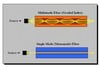
The principle of the transmission of light through multi-mode optical fiber (MMF) is best understood by taking the high-frequency approximation, which describes light as rays. The fiber consists of a core with a high refractive index n 1 (typical diameter values are 50 ?m and 62.5 ?m), surrounded by a cladding with a lower refractive index n 2 (125 ?m in diameter), most often surrounded in turn by a jacket or coating to protect the fiber from mechanical damage. The physics at the core/cladding interface cause a phenomenon...