Excavations and Foundations in Soft Soils
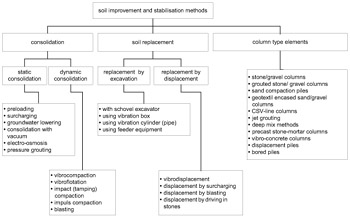
Constructions of roads, railways and other engineering structures on soft soils usually involves with problems such as excessive settlements, deformations and stability problems. To avoid or reduce such problems, there are several measures in geotechnical engineering, in which the soil improvement and stabilisation is one of them. Soil improvement and stabilisation is a broad field which may include different methods and techniques. Fig. 7.1 illustrates and categorises the different methods known in the international literature. This chapter, however, limits itself to soil stabilisation methods using pile/column like elements.
Ground improvement methods using column-like elements are used on an increasing scale in geotechnical engineering since the late 1960's. They are applied in road and railway embankments as well as in foundation of tanks, warehouses and light buildings. The basic principle of these techniques is to relieve the load on the soft soils without altering the soil structure substantially. This is achieved by installing column- or pile-type structures in a grid pattern into a bearing layer. On top of the columns a load transfer mat consisting of geotextile or geogrid reinforcements or a rigid plate is placed. The stress relieve of the soft soils results from a redistribution of the loads in the embankment through the arching effect, which is additionally stabilised by the geotextile/geogrid reinforcement by means of the so called the membrane effect. As a result the compressibility of the improved or composite ground can be reduced and...