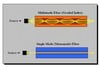
Cutting-edge fiber optic (FO) technology brings new dimensions for optical networking, long-haul optical communications, signal processing, medical diagnosis, battlefield applications and space surveillance and reconnaissance. Performance requirements for fiber core, cladding, jacket, buffer and coating will vary from application to application. Critical electrical, mechanical, thermal and optical properties of the FO elements will be summarized as a function of wavelength and operating environmental parameters such as temperature, vibration, shock and gravitational force. FO technology has potential applications to electro-optic and photonic devices, opto-electronic components, medical diagnosis and bio-engineering, missile guidance, phased array radars, satellite communications, long-haul telecommunication communications and data transmission, data links for classified missions, secured communications, underwater tracking and detection systems, programmable delay lines for electronic countermeasures (ECM) systems, towed-decoy delivery systems, spaced-based sensors, and submarine-based towed sensors.
Studies performed by the author [1] indicate that FO-based cables provide high data transmission rates, multiple voice and video channels with minimum cross-talk, and secured communications over wideband and large distances, while operating under harsh environments. These studies further indicate that FO cables are capable of operating under nuclear radiation, electromagnetic interference (EMI), and severe thermal and mechanical operating conditions, while maintaining high mechanical integrity, stable optical performance, and improved thermal performance. Requirements for various elements of the FO cable will be defined to meet the performance requirements while under harsh environments such as high-jet engine exhaust temperatures, toxic zones, and the high gravitational forces encountered under severe uncontrollable aerodynamic conditions.
1.1 Materials for Various Elements of an Optical...
Copyright Noble Publishing 2004 under license agreement with Books24x7


 TABLE OF CONTENTS