Fiber Optic Technology: Applications to Commercial, Industrial, Military, and Space Optical Systems

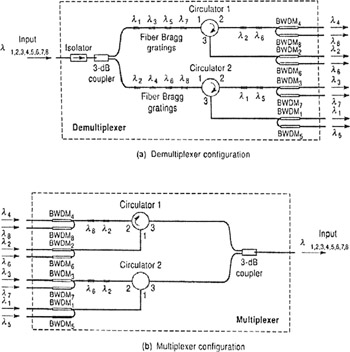
A reconfigurable network provides flexibility and wide bandwidth, which permits carriers to realize a significant return on their investment in infrastructure. The significant demands that a reconfigurable network places on DWDM components have led to a variety of sophisticated multiplexing and demultiplexing techniques as shown in Figure 6.8. Current DWDM techniques can deploy fiber Bragg gratings, thin-film filters or hybrid devices based on free-space optics and diffraction grating. The application of the above technologies is governed by factors such as price per channel, performance, footprint, scalability, manufacturability, power consumption and channel counts [6].
Major networks run many multiplexing and demultiplexing channels through single optical fibers to achieve cost-effective operation. Typically 40 channels for metropolitan hubs and 80 or more for long-haul hubs are deployed. This requires a technology capable of providing high channel count and excellent uniformity. The most popular approach uses thin-film filters coupled by circulators or interleavers to achieve high channel counts. Since the efficiency of these devices is not dependent on thermal compensation and their band pass response is relatively flat, layering of many filters in a system is feasible. The above approach suffers from some manageable problems. Although single thin-film filters have excellent optical properties their cumulative losses can degrade the overall DWDM system performance at high channel counts, when...