Fibre Channel for SANs

To give the general idea of how communication operates under the Fibre Channel protocol, we will start with a fairly detailed example of how an initially unpowered computer and disk drive device connected over a Fibre Channel link can begin interchanging data. This kind of example gives an understanding of how the various elements of Fibre Channel are used, particularly as a function of time.
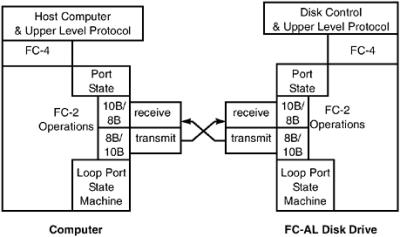
The example we will use is for a very simple configuration, consisting of a host computer and a single disk drive, connected in a two-port Arbitrated Loop topology as shown in Figure 3.1. The figure looks similar to the Point-to-point topology shown in Figure 2.3, but since both Ports in the network incorporate the NL_Port functionality for operation on an Arbitrated Loop, they will operate as NL_Ports when connected directly. It will be clear from the example which Port operations are specific to the Arbitrated Loop topology, and which operations are applicable to any topology.
In this example we will refer to the host computer as the computer, the disk drive attached over an FC-AL interface as the drive, and their respective NL_Ports as the computer NL_Port and drive NL_Port. Any time we refer to a generic N_Port or NL_Port, we are referring to computer s NL_Port. A similar set of operations and states occurs simultaneously on the drive s NL_Port as well, although we won t always emphasize it.
The example starts from...