Fibre Channel for SANs

Before meaningful data can be sent, an N_Port must determine a number of things about its operating environment. This includes such factors as whether the interconnect topology is Point-to-point, Fabric, or Arbitrated Loop; what other N_Ports are in the environment; what Classes of service the Fabric and N_Ports support; what Service Parameters are applicable to the various Ports and the various Classes of service; and what error recovery procedures will be used.
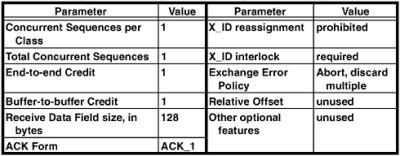
In order to determine these operating parameters, and to determine the characteristics and operating parameters of the network and the other Ports attached to it, an N_Port must perform Login Procedures. Prior to Login or following Logout, a default set of Service Parameters apply, describing the minimal service performance that an N_Port must provide. These default Service Parameters are shown in Figure 9.1. These minimal Service Parameters can be increased to higher-performance values on a F_Port and N_Port basis using the Login procedures between communicating Ports. The Login procedure is the method by which an N_Port determines these environmental characteristics.
Login is divided into two parts: Fabric Login, which determines the network operating parameters, and N_Port Login, which determines N_Port-to-N_Port operating parameters. For an N_Port s full Login, the Fabric Login is performed either once or twice, depending on whether the attached Fabric can assign Port identifiers; then an N_Port Login is performed with every N_Port in the environment with which the N_Port needs to communicate.