Fluid Dynamics with a Computational Perspective

Providing numerous illustrations, equations, references, case studies, and problems at the end of each chapter, this book offers an integrated treatment of fluid dynamics theory and computation.
 TABLE OF CONTENTS
 The simple analysis of 1.6.1 treats the velocity as a single component, directed across the surface of the control volume. Another simplistic treatment that can be informative is available for swirling flow. It also serves as an introduction to vortex dynamics.
Let the flow be axisymmetric about the x axis. Let the velocity components be u x in the axial direction and u ?, swirling about the axis of symmetry. This flow could be contained in a circular pipe with variable radius, R( x). A particle released into such a flow will translate with velocity u x, while simultaneously encircling the axis with velocity u ?. The combined motion produces a helical trajectory, as illustrated in Figure 1.10.
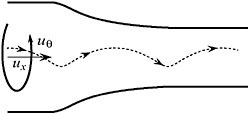
This is referred to as swirling flow. Vorticity is concomitant to swirl vorticity is the topic of 1.8. The discussion of swirl provides an introduction to the notion of streamwise vorticity. The direction about which the fluid rotates is the axis of the vortex. In this case, it is the x axis. x is also the direction of the primary component of velocity; hence, the terminology streamwise vortex refers to the fact that the axis of the vortex is in the main flow direction.
In the inviscid limit of classical fluid dynamics, it is proved that angular momentum is conserved along streamlines (Batchelor, 1967). In this case u ? r