Fluid Dynamics with a Computational Perspective
Providing numerous illustrations, equations, references, case studies, and problems at the end of each chapter, this book offers an integrated treatment of fluid dynamics theory and computation.
 TABLE OF CONTENTS
 | 1.1 | The convective derivative. Convection carries a contaminant concentration with the fluid velocity. Let the velocity be uniform in the x direction and equal to U. If the concentration is initially constant inside a circle, x 2 + y 2 = 1, and zero elsewhere, what will the concentration be after some time t? A circular patch of dye is released into a large channel. The velocity profile is not uniform, but it can be approximated locally by U + Sy, where U and S are constants. Describe how the dye patch will evolve. Ignore molecular diffusion; focus on pure convection. Show that after some time t the dye will be contained in an ellipse. |
| 1.2 | Reynolds number scaling. Derive the nondimensional forms (1.20) and (1.21) of the Navier Stokes equations. Write out the x and y components of these equations for two-dimensional flow. |
| 1.3 | One-dimensional flow analysis. Flow enters a duct from the left, with velocity u, pressure p, and constant density. It exits at right through two channels. The exit areas are A 2 = 1/2 A 1 and A 3 = 1/3 A 1. This is inviscid flow, and Bernoulli s equation is applicable. 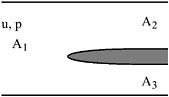 Derive a formula for the force on the divider. Explain how you chose to split the flow between the two downstream channels. |
| 1.4 | Ejector pump. A jet of air enters... |