Fluid Dynamics with a Computational Perspective

Providing numerous illustrations, equations, references, case studies, and problems at the end of each chapter, this book offers an integrated treatment of fluid dynamics theory and computation.
 TABLE OF CONTENTS
 Introductory fluid dynamics starts from the global conservation laws applied to a finite-sized control volume. Eventually, it leads to the differential form of the laws that apply to infinitesimal control volumes. As the differential laws have already been described, we proceed in the other direction to derive the global conservation equations from the differential form. The global conservation equations do not do justice to the complexity of fluid velocity fields. However, they serve to fix ideas about the nature of fluid forces, about advection of momentum, and about the relation between fluid dynamics and forces on obstacles in fluid flow.
The one-dimensional conservation laws, studied in introductory fluid dynamics, can be seen as the integral of the momentum and mass conservation laws (1.11) and (1.15) over a large control volume. This elementary statement of the governing laws is useful for designing computations, for making engineering estimates, and as a check on computations. They are summarized here as a reminder and for future reference; it is expected that the reader already has some familiarity with these basics.
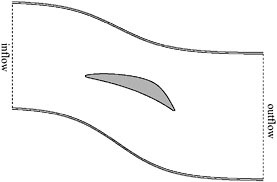
Consider a flow domain consisting of inflow and outflow boundaries and surfaces schematically, something like Figure 1.5. The divergence theorem of vector calculus can be used to integrate Eqs. (1.11) and (1.15) over the domain. The formal statement of this theorem is

The integrals are over the volume and surface of any region.  is the...