Forensic Structural Engineering Handbook
W. Gene Corley, P.E., S.E., Ph.D.
Reinforced concrete is an excellent morphological building material. In its fluid state, concrete can be placed in forms to make virtually any shape. Continuity is easily obtained by continuing reinforcement through beam-to-column connections. Once concrete is in place, creep and shrinkage assist in the redistribution of loads to locations where resistance is provided by reinforcing bars.
When defects and failures occur in a reinforced-concrete structure, careful analysis can determine the causes and point to appropriate remedial measures. Documented forensic investigations are required to demonstrate the cause of poor performance.
Any textbook may be consulted for detailed discussions of the engineering properties of concrete. Only those properties that are most common in creating problems and failures are highlighted in this section.
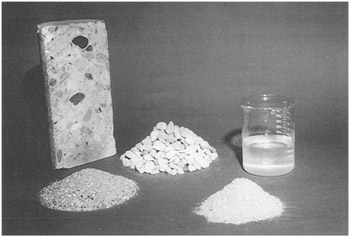
Concrete consists of three basic materials: portland cement and other cementitious materials, aggregate, and water, as shown in Fig. 12.1. When they are mixed together, the portland cement reacts chemically with water to form a hard, inexpensive structural material. The quality of the concrete improves inversely in proportion to the amount of water added. Details of mix design and concrete properties are given in the book Design and Control of Concrete Mixtures, published by the Portland Cement Association.1
After hardening, concrete resists load by first responding elastically and then continuing to deform or "creep" under sustained compressive or tensile...