Forensic Structural Engineering Handbook
Donald W. Neal, P.E.
Wood and brick and stone have been the construction materials of choice since antiquity. Development of wood as an engineered material based upon known design properties, rather than rules of thumb and artisans' judgment, is more recent. The 20th century has seen virtually all this development with an accelerating pace toward the end of the century.
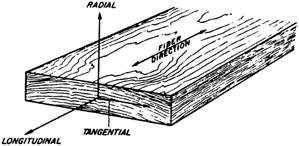
Three Distinct Grain Orientations. Wood fibers are formed in the living tree with their long dimension approximately parallel to the axis of the tree trunk. Wood is classified as anisotropic in that it has distinct and different mechanical properties in the three major axes. (See Fig. 15.1.)
| Longitudinal | Parallel to grain |
| Radial | Normal to annual rings and perpendicular to grain |
| Tangential | Tangent to annual rings and perpendicular to grain |
Wood grain direction is the wood fiber orientation. For engineering purposes, design properties are referred to as parallel or perpendicular to the grain. This means approximately parallel or perpendicular to the faces of finished lumber or timbers. The wood fiber is not precisely parallel or perpendicular to the faces of finished lumber because of natural growth characteristics or sawmill tolerances. The angle between wood fiber orientation and the faces of...