Fundamental Toxicology

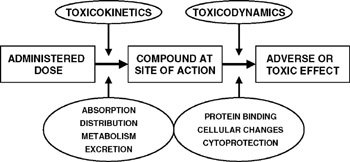
The sequence between exposure to a chemical and the generation of an adverse effect can be divided into two aspects (Figure 3.1); toxicokinetics or the delivery of the compound to its site of action and toxicodynamics or the response at the site of action. This subdivision is particularly useful in risk assessment (see later).
Toxicokinetics is the study of the movement of chemicals around the body. It includes absorption (transfer from the site of administration into the general circulation), distribution (via the general circulation into and out of the tissues), and elimination (from the general circulation by metabolism or excretion). The term toxicokinetics has useful connotations with respect to the high doses used in toxicily studies, but it may be misleading if interpreted as the movement of toxicants around the body since, as all toxicologists agree, all things are toxic and it is only the dose which renders a compound toxic . Toxicodynamics relates to the processes and changes that occur in the target tissue, such as metabolic bioactivation and covalent binding, and result in an adverse effect.
Useful toxicokinetic data may be derived using a radiolabelled dose of the chemical, i.e. in which a proton in the molecule is replaced by a tritium atom or a carbon or sulfur atom is replaced by the radioactive equivalent ( 14 C...