Fundamentals of Digital Imaging

8.6: Color Temperature

8.6 Color Temperature

It is clear from Eq. (8.19) that the characteristics of the illumination affect the appearance of colored objects. While the exact effect can be computed if all of the spectra are known, it is impossible to compute every color shift in a complex scene. The lighting industry devised a rule of thumb to estimate the change in qualitative appearance of a color using a single number to characterize the illuminant. This number is the color temperature [199, 313].

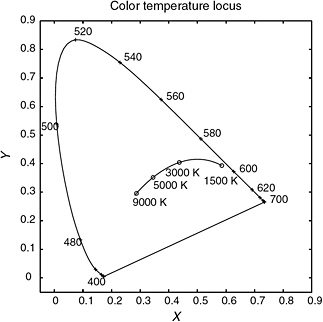
The color temperature of an illuminant is related to the color of the spectrum emitted by a black body radiator at a given temperature. Generally, the hotter an object, the whiter its spectrum will appear. The defining properties of color temperature are hue and saturation, not brightness. In other words, it is the chromaticity of the color that specifies the color temperature. Two lamps can emit different spectra but have the same chromaticity and, thus, the same color temperature. They may not be metamers since they may have different luminances. The range of color temperatures is shown in Fig. 8.20.


Figure 8.20: Color temperature locus.

Note that since the spectra of different lamps with the same color temperature are different, the appearance of objects under the two may be different. This can be a problem when evaluating images that demand high quality color matching at different viewing locations.

While the color temperature of the black body radiator is a well defined curve on the chromaticity diagram,...

UNLIMITED FREE
ACCESS
TO THE WORLD'S BEST IDEAS

SUBMIT
Already a GlobalSpec user? Log in.

This is embarrasing...

An error occurred while processing the form. Please try again in a few minutes.

Customize Your GlobalSpec Experience

Category: Color Meters and Appearance Instruments
Finish!
Privacy Policy

This is embarrasing...

An error occurred while processing the form. Please try again in a few minutes.