The impulse signal is used extensively in this text, particularly in Chapters 5 and 6. The impulse signal is represented by the Dirac delta function, ?(t), [201, 107]. It has two major applications in signal and image processing. It is the basis for describing the transformation of signals by a linear, time-invariant system, and it is used to describe sampling of analog signals to create discrete signals. Mathematically, the Dirac delta function is a generalized function, since it does not have a finite value at every point. For this reason, the function must be treated in special ways. See [164, 140] for a more mathematically detailed treatment.
A.1 Basic Definition
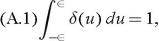
The function is defined as zero for t ? 0 with an area of unity. The unit area property can be written
for any  > 0. The restriction, > 0, is assumed to avoid possible negating of the integral if the direction of integration is from positive to negative. The most useful property of the delta function is that of sifting, e.g., extracting single values of a continuous function. This is defined by the integral
This shows the production of a single sample. We would represent the sampled signal as a signal that is zero everywhere except at the sampling time, s 0( t) = s( t 0) ?( t ? t 0). The sampled signal can be represented graphically by using an arrow, as shown in Fig. 2.2.
Copyright Cambridge University Press 2008 under license agreement with Books24x7


 TABLE OF CONTENTS