Fundamentals of High-Frequency CMOS Analog Integrated Circuits
4.6: The Low-Noise Amplifier (LNA)

4.6 The Low-Noise Amplifier (LNA)

LNA is the acronym used for a class of amplifiers, the low-noise amplifiers , commonly employed as the input stages of wireless receivers. Since the incoming signal from an antenna is usually weak, the unavoidable noise generated in the amplifier must be as low as possible, to obtain an acceptable signal-to-noise ratio at the output of the amplifier. Therefore, one of the key design goals for the LNA is a low noise contribution to the input signal, together with a good impedance matching to the signal source, a sufficiently large output signal dynamic range and certainly a low power consumption.


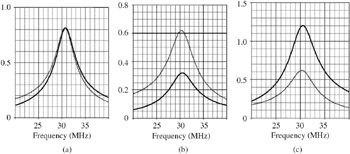
Figure 4.33: The input (solid line) and output port (dashed line) voltages (in volts) of the gyrator for different C 2/C 1 ratios: (a) C 1 = C 2 = 5 pF, (b) C 1 = 10 pF, C 2 = 2.5 pF, (c) C 1 = 2.5 pF, C 2 = 10 pF.

Since LNAs are being used as the input stage of receivers, they must be tuned (or be tunable) to the carrier frequency of the transmitter that we intend to receive. Therefore, LNAs are inherently considered to be tuned amplifiers . The bandwidth of the amplifier must be large enough to cover the side-bands of the modulated carrier. But owing to the low Q values of the on-chip inductors, the bandwidth usually becomes larger than necessary and the signals that remain...

UNLIMITED FREE
ACCESS
TO THE WORLD'S BEST IDEAS

SUBMIT
Already a GlobalSpec user? Log in.

This is embarrasing...

An error occurred while processing the form. Please try again in a few minutes.

Customize Your GlobalSpec Experience

Category: Noise Figure Meters
Finish!
Privacy Policy

This is embarrasing...

An error occurred while processing the form. Please try again in a few minutes.