Fundamentals of Nonlinear Behavioral Modeling for RF and Microwave Circuits
3.2: BAND-PASS AND COMPLEX-ENVELOPE DOMAIN MODEL FORMALISM

3.2 BAND-PASS AND COMPLEX-ENVELOPE DOMAIN MODEL FORMALISM

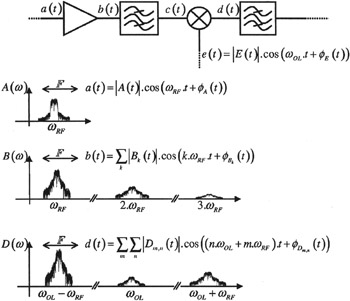
A communication TX/RX is commonly represented as a chain of nonlinear blocs (synthesizers, amplifiers, converters, modulators, and so forth) and linear blocs (filters, multiplexers, and so forth) as sketched in Figure 3.2.


Figure 3.2: RF communication chain block diagram.

For illustration purposes, let us consider an idealized TX chain driven by a signal consisting of a modulation multiplex with a total bandwidth Bw, around a center carrier ? RF. Further, let us consider that ? LO is the local oscillator frequency. It is known that the blocs' nonlinear characteristics will broaden the modulation bandwidth and generate intermodulation products of the two carriers ? RF and ? LO, so that any signal in the TX chain will be expressed in the general form:

(3.1)

Equation (3.1) is usually expressed in the analytic signal notation:

(3.2)

where we refer to as the complex envelope of the carrier intermodulation product of rank m, n. The complex envelope represents the useful signal (eventually distorted) in the baseband, which is commonly expressed in the following in- phase and quadrature signal notation

(3.3)

In general the modulation bandwidth Bw is small compared to the carriers ? RF and ? LO, so we refer to signal (3.2) as a narrowband signal. In these conditions it is more effective to manipulate directly the complex-envelope signals and make abstraction of the carrier frequencies when studying...

UNLIMITED FREE
ACCESS
TO THE WORLD'S BEST IDEAS

SUBMIT
Already a GlobalSpec user? Log in.

This is embarrasing...

An error occurred while processing the form. Please try again in a few minutes.

Customize Your GlobalSpec Experience

Category: RF Transmitters
Finish!
Privacy Policy

This is embarrasing...

An error occurred while processing the form. Please try again in a few minutes.