Handbook of Electrical Design Details, Second Edition
For well over a century, electric motors of various kinds have been powering machine tools, process machinery, street cars, appliances, pumps, fans, tools, and many other products. Electric motors are being been purchased as independent sources of mechanical power for a wide range of systems and as components embedded in manufactured products such as machine tools, material handling equipment, and appliances. Motors range in size from fractional-horsepower clock motors to industrial giants rated for more than 500 hp, and they provide the driving power for equipment as diversified as electric trains, elevators, escalators, street cars, cranes, and ocean-going ships.
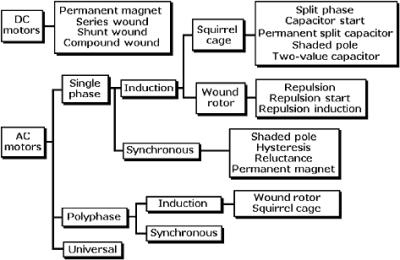
Electric motors are broadly classified as direct current (DC) or alternating current (AC), although universal motors can be powered by either AC or DC. Motor identification and classification are complicated and can be quite confusing because of the similarities in features and construction that span the divide between AC and DC motors. To clarify the situation, Fig. 10-1 shows the interrelationships of the leading characteristics of motors. It identifies the four generic types of DC motors and the five generic types of AC motors, excluding the universal motor. There are both single-phase and polyphase induction and synchronous motors, and both single-phase and polyphase induction motors can have either squirrel-cage or wound rotors.
The electric motors discussed in this chapter can be catalog or even off-the-shelf distributor models, or they can be custom-designed and built specifically for one customer. The...