Handbook of Optics: Classical Optics, Vision Optics, X-Ray Optics, Vol III, Second Edition

Chapter 22: Crystal Monochromators and Bent Crystals

Peter Siddons
National Synchrotron Light Source
Brookhaven National Laboratory
Upton, New York

22.1 CRYSTAL MONOCHROMATORS

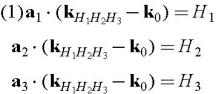
For X-ray energies higher than 2 keV or so, gratings become extremely inefficient, and it becomes necessary to utilize the periodicity naturally occuring in a crystal to provide the dispersion. Since the periodicity in a crystal is 3-dimensional, the normal single grating equation must be replaced by the three grating equations, one for each dimension, called the Laue equations,1 as follows:


where the a s are the repeat vectors in the three dimensions, the k s are the wave vectors for the incident and scattered beams, and the H s are integers denoting the diffraction order in the three dimensions. All of them must be simultaneously satisfied in order to have an interference maximum (commonly called a Bragg reflection). One can combine these equations into the well-known Bragg s law2 for one component of the crystalline periodicity (usually referred to as a set of Bragg planes),


where n is an integer indicating the order of diffraction from planes of spacing d, and ? is the angle between the incident beam and the Bragg planes. This equation is the basis for using crystals as X-ray monochromators. By choosing one such set of Bragg planes and setting the crystal so that the incident X rays fall on these planes, the wavelength of the light reflected depends on the angle of incidence of the light. Table 1 shows some commonly used crystals and the spacings...

UNLIMITED FREE
ACCESS
TO THE WORLD'S BEST IDEAS

SUBMIT
Already a GlobalSpec user? Log in.

This is embarrasing...

An error occurred while processing the form. Please try again in a few minutes.

Customize Your GlobalSpec Experience

Category: Monochromators
Finish!
Privacy Policy

This is embarrasing...

An error occurred while processing the form. Please try again in a few minutes.