Handbook of Optics: Classical Optics, Vision Optics, X-Ray Optics, Vol III, Second Edition

Alan Michette
King s College London
Physics Department
Strand, London, United Kingdom
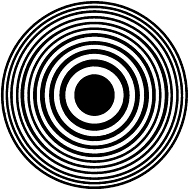
The focusing properties of zone plates were first discussed in the latter part of the nineteenth century,1 ,2 ,3 and their use as X-ray optical components was originally suggested by Baez.4 In their most common form, they are circular diffraction gratings with radially increasing line densities; linear,5 square,6 elliptical,7 and hyperbolic7 ,8 zone plates (among others) have also been considered, but only the circular and, to a lesser extent, linear and elliptical forms have generally been used. The properties of zone plates may be described, without loss of generality, by considering the circular form (Fig. 1).
A linear diffraction grating (see Chaps. 21 and 22) with a constant period, d, working in the first order diffracts radiation through an angle, ?= sin ?1 ?/d, ? ?/d in the small-angle approximation. A circular grating with constant period could therefore be used to form an axial-line focus of a point source, as shown in Fig. 2a ; note that diffraction from opposite orders contributes either side of the axis. The distance from a radial point, r, on the grating to a point on the axis is z= r/tan ? ? rd/ ?. If the period is now made to decrease as the radius increases, then z can be made constant and the grating then acts as a lens,...