Hertzian Tales: Electronic Products, Aesthetic Experience, and Critical Design

The rapid expansion of knowledge and technical development has swept us into a world beyond our grasp; the face of nature is alien once again. Like the forest and the mountains of medieval times, our new environment harbours strange menacing beasts, invisible viruses, atoms, mesons, protons, cosmic rays, supersonic waves. Gyorgy Kepes
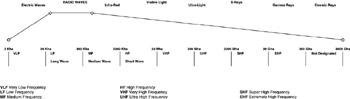
It might seem strange to write about radio, [1] a long-established medium, when discussion today centers on cyberspace, virtual reality, networks, smart materials and other electronic technologies. But radio, meaning part of the electromagnetic spectrum (figure 6.1), is fundamental to electronics. Objects not only de-materialize into software in response to miniaturization and replacement by services, but literally dematerialize into radiation. All electronic products are hybrids of radiation and matter. This chapter does not discuss making the invisible visible, or visualizing radio, but explores the links between the material and immaterial that lead to new aesthetic possibilities for life in an electromagnetic environment. Whereas cyberspace is a metaphor that spatializes what happens in computers distributed around the world, radio space is actual and physical, even though our senses detect only a tiny part of it.
It is just over one hundred years since electricity generation started, seventy since radio transmissions began, and fifty since radar and telecommunications entered our environment. The twentieth century has seen space evolve into a complex soup of electromagnetic radiation. The extrasensory parts of the electromagnetic spectrum form more and more of our...