HF Filter Design and Computer Simulation
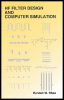
3.8: Solenoid With Shield

3.8 Solenoid With Shield

Solenoids produce magnetic flux which has the potential to link with adjacent solenoids or conductors and therefore provide undesired transmission paths which affect the filter response. Electrostatic coupling also occurs between solenoids when the voltage potential on one solenoid induces a voltage potential on a second solenoid via mutual capacitance. To avoid these difficulties, solenoids are enclosed within a housing of good conductivity or high permeability. At low frequencies, shields with a high permeability are used. At high frequencies, the eddy currents induced in conducting shields effectively block both magnetic and electrostatic fields.

Shielding a solenoid increases C e, lowering the resonant frequency, and increasing the loss resistance, thus lowering Q u. Higher shield conductivities reduce shield losses and minimize Q u degradation. The solenoid inductance is decreased when non-magnetic shield material is used and is increased when magnetic materials are used. Greater shield spacings from the solenoid minimize all of the above effects.

Figure 3-9 gives the reduction in inductance caused by a conductive shield as functions of l/ d and the ratio of the solenoid to shield diameter [7]. The ends of the solenoid are assumed to be at least one solenoid radius from the ends of the shield. As expected, if the solenoid diameter is small relative to the shield diameter, the shield is effectively removed and its effect is small. However, even if the shield diameter is twice that of the solenoid, the effect is significant...

UNLIMITED FREE
ACCESS
TO THE WORLD'S BEST IDEAS

SUBMIT
Already a GlobalSpec user? Log in.

This is embarrasing...

An error occurred while processing the form. Please try again in a few minutes.

Customize Your GlobalSpec Experience

Category: Linear Solenoids
Finish!
Privacy Policy

This is embarrasing...

An error occurred while processing the form. Please try again in a few minutes.