Highway Engineering Handbook: Building and Rehabilitating the Infrastructure

Part of the process in obtaining a driveway permit is to determine where the driveway will be located. The following guidelines may be used to establish this location.
Wherever possible, drives should be located in accordance with the intersection sight distance criteria (see Table 2.3). Special consideration should be given to the location of drive access to high-volume traffic generators such as shopping centers and industrial plants and parks, as well as other types of development having similar traffic characteristics. These should be treated as standard intersections with appropriate spacing to the nearest intersection. A driveway serving all directions of traffic should be located a minimum of 600 ft from the nearest major highway or street intersection. A new driveway should not be located where it will create an offset intersection opposite an existing street, highway, or major commercial driveway.
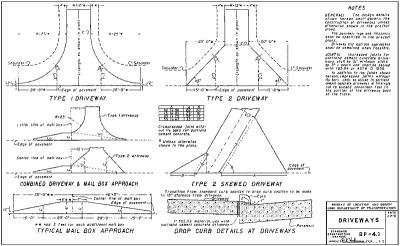
Rural residential drives and field drives should normally conform to the type 1 design shown in Fig. 2.49 (Ref. 14). New drives should intersect the highway at an angle between 70 and 90 . In some cases, however, it may be necessary to retain existing drive angles that vary from these desirable angles.
If the project involves existing drives, the existing width is normally retained unless it is less than 12 ft. In that case, it should be widened to provide a 12-ft...