Hydrodynamic Stability, Second Edition

Containing a large number of problems that provide exercises as well as solutions, this book offers a clear and unparalleled explanation of the fundamentals of hydrodynamic stability.
 TABLE OF CONTENTS
 Yet not every solution of the equations of motion, even if it is exact, can actually occur in Nature. The flows that occur in Nature must not only obey the equations of fluid dynamics, but also be stable.
L.D.Landau & E.M.Lifshitz (1959)
The essential problems of hydrodynamic stability were recognized and formulated in the nineteenth century, notably by Helmholtz, Kelvin, Rayleigh and Reynolds. It is difficult to introduce these problems more clearly than in Osborne Reynolds s (1883) own description of his classic series of experiments on the instability of flow in a pipe.
The experiments were made on three tubes . The diameters of these were nearly 1 inch, 1/2 inch and 1/4 inch. They were all fitted with trumpet mouthpieces, so that the water might enter without disturbance. The water was drawn through the tubes out of a large glass tank, in which the tubes were immersed, arrangements being made so that a streak or streaks of highly coloured water entered the tubes with the clear water.
The general results were as follows:-
When the velocities were sufficiently low, the streak of colour extended in a beautiful straight line through the tube, Fig. 1.1(a).
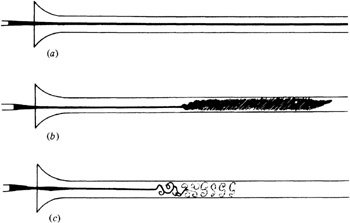
Fig. 1.1: (a) Laminar flow in a pipe. (b) Transition to turbulent flow in a pipe. (c) Transition to turbulent flow as seen when illuminated by a spark. (From Reynolds 1883.)If the water in the tank had not quite settled to rest, at sufficiently low velocities, the...