Hydrodynamic Stability, Second Edition
Containing a large number of problems that provide exercises as well as solutions, this book offers a clear and unparalleled explanation of the fundamentals of hydrodynamic stability.
 TABLE OF CONTENTS
 In discussing the governing equations for a viscous fluid we shall again suppose that the basic steady flow is of the form given by equation (21.1). For a viscous fluid, however, U * (z * ) can no longer be an arbitrary function of z * but must satisfy the equation of motion
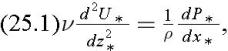
where d P */d x *=constant. The class of strictly parallel flows is thus somewhat limited since U * can at most be quadratic in z * . This includes, however, two important special cases which in dimensionless form are:
Plane Couette flow:

where V=the velocity of the upper plate and L=half the channel width; and
Plane Poiseuille flow:

where V=the maximum velocity at the centre of the channel= ?( L 2/2 ?v)d P */d x* and L=half the channel width. We have therefore a one-parameter family of strictly parallel flows which can be thought of as a linear combination of plane Couette flow and plane Poiseuille flow. The governing equations will be derived in this section on the assumption that the basic flow is strictly parallel. More generally, however, the resulting equations can often be used to discuss the stability of so-called nearly parallel flows. A twodimensional basic flow U= {U(x , z), 0, W(x, z)} is said to be nearly parallel if

The class of nearly...