Hydrodynamic Stability, Second Edition

Containing a large number of problems that provide exercises as well as solutions, this book offers a clear and unparalleled explanation of the fundamentals of hydrodynamic stability.
 TABLE OF CONTENTS
 In 27 we found that the local turning-point approximations to the solutions of the Orr-Sommerfeld equation could be expressed in terms of double integrals of Airy functions. These approximations are simply the first terms in the inner expansions of the solutions. To infer the general structure of the uniform expansions, however, it is necessary to characterize the class of functions in terms of which the inner expansions of the solutions can be expressed to all orders. It is natural therefore to begin with a discussion of Airy functions and the required class of functions then emerges in two stages by a systematic generalization of the Airy functions. The present discussion is a modified version of the account given by Reid (1972).
Consider first the solutions of Airy s equation u ? ?zu=0 which are often taken as Ai (z) and Bi (z). When z is real, these solutions are numerically satisfactory in the sense of J.C.P.Miller (cf. Olver 1974, pp. 154 155). When z is complex, however, Ai (z) is recessive in the sector  , but there is no sector in which Bi (z) is recessive. Furthermore, since Airy s equation is invariant with respect to the transformations
  , this suggests that we consider three solutions defined by
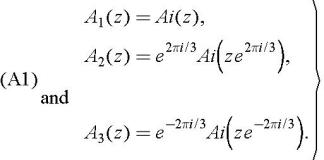
The basic idea here is due to Olver (1974), p. 413, but the present notation differs slightly from his. The solutions A k (z) ( k=1,...