Introduction to Clustering Large and High-Dimensional Data
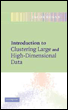
Focusing on a few of the most important clustering algorithms, this book provides a detailed account of these major models in an information retrieval context.
 TABLE OF CONTENTS
 This chapter describes a clustering algorithm designed to handle l 2 unit norm vectors. The algorithm is reminiscent to the quadratic k-means algorithm (Algorithm 2.1.1), however the distance between two unit vectors x and y is measured by d( x , y) = x T y (so that the two unit vectors x and y are equal if and only if d( x , y) = 1). We define the set  housing centroids as a union of the unit n ? 1-dimensional l 2 sphere

centered at the origin and the origin (when it does not lead to ambiguity we shall denote the sphere just by  ).
).
The chapter is structured similar to Chapter 2. First, we introduce the batch spherical k-means algorithm, then the incremental version of the algorithm is described. Finally, the batch and incremental iterations are combined to generate the spherical k-means algorithm. We conclude the chapter with a short discussion that relates quadratic and spherical k-means algorithms.
To introduce centroids one has to modify formula (2.1.1). For a set of vectors  = { a 1 , , a m} ? R n, and the distance-like function d( x , a) = a T x define centroid c = c ( ) of the set as a solution of the maximization problem