Introduction to Structural Dynamics

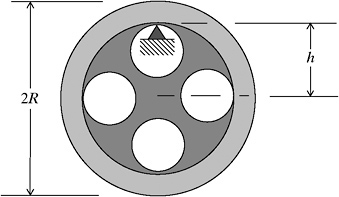
| Q: | 2.1 (a) As shown in Figure 2.13, a symmetric, but irregularly shaped, circular object is suspended a distance h above its geometric center. The symmetry of the object and the homogeneity of the material gives assurance that the geometric center is also the center of mass. The circular object has a weight w, an outer radius R, and an average thickness P and its astrological sign is Leo. When set to swinging in the plane of the paper from its support point, through small angular amplitudes, its observed period of vibratory motion is T. What is the magnitude of the object s mass moment of inertia about an axis through the center of mass and perpendicular to the plane of the paper? Figure 2.13: Exercise 2.1: Measuring a mass moment of inertia. (b) Conceptually design an experiment using a pendulum for the accurate determination of the acceleration of gravity. Hint: One approach is to consider using a long object of imperfect geometry that can be physically suspended from two different points along its length where each suspension point is a different, far distance from the object s center of mass. The two suspensions can provide two pieces of information that allow the calculation of the mass moment of inertia and then the acceleration of gravity. |
|
| Q: | 2.2 (a) Linearize Eq. (2.6), and write the expression for the small deflection natural (circular) frequency and natural period. (b) |