Introduction to Structural Dynamics

Consider a function f( t) that is periodic with period [2] T. Let the function f( t) satisfy the Dirichlet [3] conditions. From Ref. [II.1], these conditions are that, in addition to being periodic, f( t) is a bounded function that in any one period has at most a finite number of local maxima and local minima and a finite number of points of discontinuity. Then the following trigonometric series for f( t) converges to that function at all points where the function f( t) is continuous and converges to the average of the right- and left-hand limits of f( t) at each point where f( t) is discontinuous:
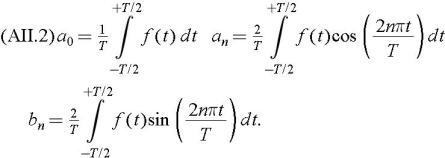
On the basis of the orthogonality of these sine and cosine functions over any t-interval of length T, the series coefficients of the sine and cosine functions, a 0, a n, b n, for all n, can be determined from the relations
In the above integrations, the intervals of integration can be any time interval of total duration T, such as (0, T).
The above Fourier series can also be written in terms of spatial variables, that is, with x and L, respectively, replacing t and T. Although their importance per se has faded in the digital age, such Fourier series can have many uses. For example,...