Iterative Methods for Sparse Linear Systems, Second Edition

6.6: The Symmetric Lanczos Algorithm

6.6 The Symmetric Lanczos Algorithm

The symmetric Lanczos algorithm can be viewed as a simplification of Arnoldi's method for the particular case when the matrix is symmetric. When A is symmetric, then the Hessenberg matrix H m becomes symmetric tridiagonal. This leads to a three-term recurrence in the Arnoldi process and short-term recurrences for solution algorithms such as FOM and GMRES. On the theoretical side, there is also much more that can be said on the resulting approximation in the symmetric case.

6.6.1 The Algorithm

To introduce the Lanczos algorithm we begin by making the observation stated in the following theorem.

Theorem 6.19

Assume that Arnoldi's method is applied to a real symmetric matrix A. Then the coefficients h ij generated by the algorithm are such that

In other words, the matrix H m obtained from the Arnoldi process is tridiagonal and symmetric.

Proof

The proof is an immediate consequence of the fact that H m = V T mAV m is a symmetric matrix that is also a Hessenberg matrix by construction. Therefore, H m must be a symmetric tridiagonal matrix.

The standard notation used to describe the Lanczos algorithm is obtained by setting

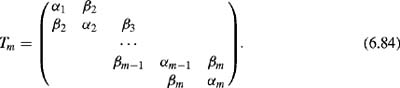
and, if T m denotes the resulting H m-matrix, it is of the form

This leads to the following form of the MGS variant of Arnoldi's method, namely, Algorithm 6.2.

ALGORITHM 6.15: Lanczos Algorithm
  1. Choose an initial vector ? 1 of 2- norm...

UNLIMITED FREE
ACCESS
TO THE WORLD'S BEST IDEAS

SUBMIT
Already a GlobalSpec user? Log in.

This is embarrasing...

An error occurred while processing the form. Please try again in a few minutes.

Customize Your GlobalSpec Experience

Category: Commercial Matrix Displays
Finish!
Privacy Policy

This is embarrasing...

An error occurred while processing the form. Please try again in a few minutes.