IXP2400/2800 Programming: The Complete Microengine Coding Guide
The Application

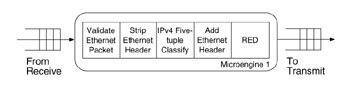
The flow of packets in the application is shown in Figure 6.1. The packet-processing code takes packets from the scratch ring on which the receive code places packets. The code then processes the packets. When processing is complete, the packets are put on one of the SRAM rings from which the transmit code reads. In between these steps, the Ethernet header of the packet is validated and removed, the packet is classified based on the fields in the IP header, a new Ethernet header is added, and RED congestion avoidance is done. Each of the blocks in this figure is implemented as a microblock.Writing microblocks implies that the code is written without knowledge of the other microblocks, which allows microblocks to be reused across different applications with different microblocks. So for example, the IPv4 five-tuple classification microblock is used to process packets that arrived as Ethernet frames, but it doesn t care about the encapsulation in which the packet arrived. The classification microblock could also be used to process packets that arrive in other encapsulations, such as Packet-Over-SONET.


Figure 6.1: The Sample Application Data Flow

The code in this chapter is implemented as Intel IXA SDK 3.0 microblocks using dispatch loops as described in Chapter 3. We have also implemented a core component for the microblock that adds the Ethernet header to the packet. A later section of this chapter describes the design and implementation aspects of this core component.

But enough of the big picture, you need the...

UNLIMITED FREE
ACCESS
TO THE WORLD'S BEST IDEAS

SUBMIT
Already a GlobalSpec user? Log in.

This is embarrasing...

An error occurred while processing the form. Please try again in a few minutes.

Customize Your GlobalSpec Experience

Category: Packet Generators
Finish!
Privacy Policy

This is embarrasing...

An error occurred while processing the form. Please try again in a few minutes.