The Little Black Book of Reliability Management

I have not failed. I've just found 10,000 ways that won't work. Thomas Alva Edison
In the overall process of handling failures and their causes, a specific path to failure is assumed. It is necessary to characterize all failures using paths with common characteristics, so information can be organized in a consistent manner. On a number of occasions throughout this book, I have used an analogy with the path of a trip from one place to another to help describe how we use information concerning various points along that path, to provide insight concerning the overall path.
In this chapter, I will describe the overall path to failure and all the significant milestones along the way. Although you are likely to deal with hundreds or thousands of failure paths, all will share these same characteristics.

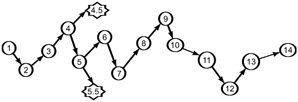
Assume that the diagram above charts the path of a failure from the beginning until the conclusion of the investigation. The numbers represent the following events:
1. Systemic Cause
A weakness exists in the organization or system. This weakness creates an opening that allows members of the organization to act in a manner that will result in the introduction of defects.
2. Human Cause
A specific individual either takes an action or fails to take an action that ultimately results in the introduction of a defect into an equipment item.
3. Physical Cause
A circumstance now exists that allows some form of deterioration to begin. This circumstance may be the leakage of water into...