LTE for 4G Mobile Broadband: Air Interface Technologies and Performance

9.1: PN Sequence

9.1 PN Sequence

A pseudo-noise (PN) sequence is extensively used in the LTE system for various purposes such as scrambling of reference signals, scrambling of downlink and uplink data transmissions as well as in generating various hopping sequences.

9.1.1 Maximal length sequence

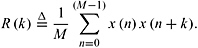
A PN sequence can be generated by using linear feedback shift registers (LFSR). The shiftregister sequences with the maximum possible period for an l-stage shift register are called maximal length sequences or m-sequences. A necessary and sufficient condition for a sequence generated by an LFSR to be of maximal length ( m-sequence) is that its corresponding polynomial be primitive. The periodic autocorrelation function for an m-sequence x( n) is defined as:

(9.1)

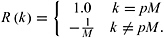
The periodic autocorrelation function R ( k) equals:

(9.2)

We note that the autocorrelation of an m-sequence is 1 for zero-lag, and nearly zero ( ?1 /M, where M is the sequence length) for all other lags. In other words, the autocorrelation of the m-sequence can be said to approach unit impulse function as m-sequence length increases.

9.1.2 Gold sequence

The Gold sequences have been proposed by Gold in 1967 [1]. These sequences are constructed by EXOR-ing two m-sequences of the same length as shown in Figure 9.1. Thus, for a Gold sequence of length n = 2 l ?1 we need to use two LFSR sequences, each of length n = 2 l ?1. If...

UNLIMITED FREE
ACCESS
TO THE WORLD'S BEST IDEAS

SUBMIT
Already a GlobalSpec user? Log in.

This is embarrasing...

An error occurred while processing the form. Please try again in a few minutes.

Customize Your GlobalSpec Experience

Category: IC Timers
Finish!
Privacy Policy

This is embarrasing...

An error occurred while processing the form. Please try again in a few minutes.