LTE for 4G Mobile Broadband: Air Interface Technologies and Performance

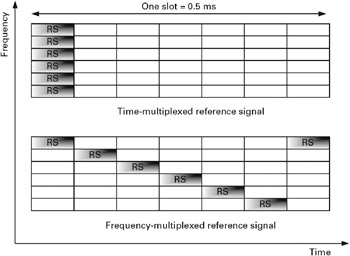
In the LTE system design phase, both time-division multiplexing (TDM) and frequency-division multiplexing (FDM) approaches were considered for reference signal multiplexing. These approaches are illustrated in Figure 9.8. A major benefit cited for the TDM approach was the possibility of employing micro-sleep mode at the UE. The idea was that scheduling control information could also be time-multiplexed, for example, in the OFDM symbols just following the TDM pilot. This way UE can perform channel estimation from the TDM pilot and can immediately decode control information. After decoding the TDM control information, UE will know if it is scheduled or not in the current subframe. In the case where the UE determines that it is scheduled in the current frame, it will continue buffering the remaining transmission within the subframe. In the case where the UE determines that it is not scheduled in the current subframe, it can turn off its receiver thus enabling battery-power savings.
However, the drawback of the TDM reference signal approach is its inability to share transmission power between the reference signals and data transmission. The power sharing is particularly important for cases where the reference signal power needs to be boosted relative to the data power to enable better channel estimates. On the other hand, the FDM approach, which is also referred to as the fully scattered reference signals scheme, provides the flexibility to share and balance power between reference...