Machinability of Powder Metallurgy Steels
In wrought steels, phosphorus causes embrittlement by grain boundary segregation. Consequently, the phosphorus concentration is limited to the lowest possible value. On the other hand, phosphorus belongs to the group of the cheapest alloying elements with the highest hardening effect in iron. In sintered steel, P is a widely used sintering activator, as stated in chapter 2.5.2.4.
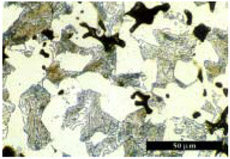
The machinability of Fe-P-(C) alloys depends on the material characteristics as for other steels, with the exception of the inadequate relation between the strength and elongation in phosphorus-alloyed steels compared to those alloyed with other elements, i.e. by relatively high strength with relatively high ductility which prevents the very simple 'correlation' as higher strength-poorer machinability. Figure 7.58 shows the characteristic microstructure of Fe-P steel.
High strength properties are achieved by further addition of carbon, copper and/or nickel used for the production of structural parts. Carbon-free Fe-P alloys are employed usually as soft magnetic materials.
For testing the machinability of P-containing steels the effect of other strengthening additions can be of significant importance. Among those, copper, in some other alloys enhancing the machinability and nickel, deteriorating machinability, can be representative. Both copper and nickel cause strengthening of Fe-P steels. Their effect in amounts of 1 to 4% on density and hardness of Fe-(0.3,0.6)P-(0,0.5,0.9)C (PASC30, PASC60) is listed in Tabs. 7.29 and...