Machinability of Powder Metallurgy Steels
From the data presented so far it follows that the machinability of differently sintered high strength, high hardness alloy steels with additions of various types of machining agents can be characterised as low to poor. This restricts the wider use of these steels for the production of highly stressed complex shaped parts. In addition to this, higher alloying is most effective in the heat treated state of the materials which treatment makes them virtually unmachinable. This is the reason for the development and application of some PM processing steps with special attention to facilitate the machining of these steels and/or for testing the cutting conditions and cutting tool and geometry for such parts.
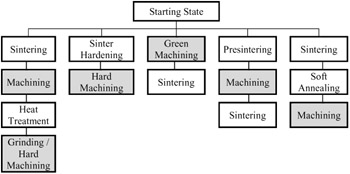
In this connection, it is important to note again that the machining conditions of a PM part are closely linked to the overall history of production and the processing steps used up to the final properties of a sintered part with very complex shape. The main production routes, including hardening processes with corresponding machining methods applicable for high strength, high hardness steels, which are hardly machinable, are shown in Fig. 7.96.
The first route is the most conventional one. If necessary a supplementary grinding or hard machining step can be applied after heat treatment (through hardening, surface hardening) of parts with an apparent hardness of 50 60 HRC.
The...