Making Technology Work: Applications in Energy and the Environment

WIND ENERGY

For centuries wind was used throughout the world as an important source of mechanical power for pumping water, grinding grain, and other applications. In later times wind power fell into disuse in most advanced economies. Its intermittent nature made it uncompetitive with the round-the-clock availability of steam power from inexpensive fossil fuels. Recently, however, the use of wind power, especially for electricity generation, has been increasing in both the advanced and developing countries. Its contribution to the world s supply of electricity is still small (less than 1%), though in some parts of the world it is growing rapidly. The total wind energy resource is very large. About 1% of the incoming solar flux goes to drive the winds, or about 1,200 terawatts (1 terawatt= 10 12 watts). This is roughly 100 times the current global rate of energy use. But only a very tiny fraction of this energy could ever be captured economically.

Technical Performance of Wind Machines

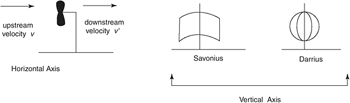
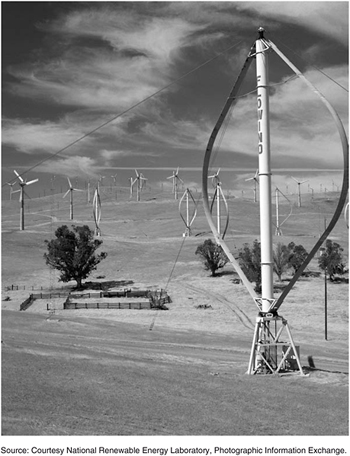
Over the years many different types of wind turbines have been proposed with both horizontal and vertical axes of rotation. Some of these are illustrated in Figure 3.5. A Darrius-type wind turbine at the large wind farm at Altamont Pass, California is shown in Figure 3.6.


Figure 3.5: Examples of different wind turbine types.

Figure 3.6: A Darrius-type vertical axis wind turbine.

The basic concept of wind power is straightforward. The wind s kinetic energy is converted into the rotational energy of the turbine blades, which is then converted to...

UNLIMITED FREE
ACCESS
TO THE WORLD'S BEST IDEAS

SUBMIT
Already a GlobalSpec user? Log in.

This is embarrasing...

An error occurred while processing the form. Please try again in a few minutes.

Customize Your GlobalSpec Experience

Category: Wind Turbines
Finish!
Privacy Policy

This is embarrasing...

An error occurred while processing the form. Please try again in a few minutes.