Making Technology Work: Applications in Energy and the Environment

Since the beginning of the industrial age, growing quantities of gases have been released into the atmosphere with the ability to trap sunlight and thus with the potential to cause an increase in the mean global temperature. A temperature increase of just a few degrees will lead to climate changes that have the potential to cause irreversible ecological impacts with enormous accompanying economic and social dislocations. The purpose of this chapter is to describe how the United States and other nations are dealing with this complex issue.
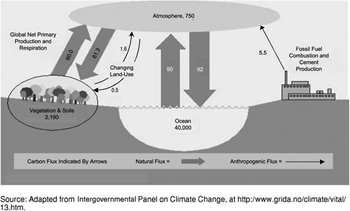
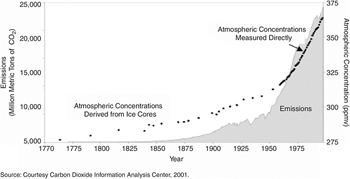
The quantity of gases for which human activity is responsible is small relative to both the total atmospheric inventory and the fluxes from natural sources such as plant growth and decay. As Figure 6.1 shows, the flux of carbon released today by the burning of fossil fuels is a very modest fraction of the carbon fluxes that are naturally exchanged between the atmosphere and the upper layers of the ocean and between the atmosphere and the terrestrial biosphere. But those natural flows had previously been in close balance, and the human contribution is growing rapidly (see Figure 6.2). This anthropogenic perturbation has the potential to destroy the delicate radiative balance that maintains the Earth s surface temperature.
Global warming is perhaps the most complex technology issue on the public policy agenda. The...