Making Technology Work: Applications in Energy and the Environment

SOLAR PHOTOVOLTAIC TECHNOLOGY

Solar photovoltaic technology is an attractive power option because it produces electricity simply and directly from a renewable source and in principle allows application on a small scale, such as an individual residence. As we shall see, however, the technology is not yet economic in the U.S. power market, and significant additional progress will be necessary before widespread deployment can occur. The technology is likely to be deployed earlier in remote applications or in less developed countries where there is no utility grid.

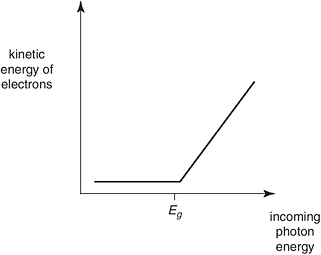
Photovoltaic energy is generated through the photovoltaic effect. Photons of energy E = h ? = hc/ ? hit a semiconductor material with band gap E g, creating an electron-hole pair. Here, as before, h is Planck s constant, c the speed of light, and ? and ? the frequency and wavelength of the light. The resulting kinetic energy of the electrons gives rise to a current. The photovoltaic effect is illustrated in Figure 3.13.


Figure 3.13: The photoelectric effect.

Photovoltaic solar cells are made from semiconductor materials doped to make electron donating and electron accepting regions. The materials are usually based on silicon, Si, or gallium arsenide, GaAs. A sheet of amorphous silicon solar cells is shown in Figure 3.14. The efficiency of photovoltaic materials depends upon the relationship of the band gap of the material, E g, to the solar spectrum (see Figure 3.15). The ideal band gap is between 1.2 and 1.4 eV because...

UNLIMITED FREE
ACCESS
TO THE WORLD'S BEST IDEAS

SUBMIT
Already a GlobalSpec user? Log in.

This is embarrasing...

An error occurred while processing the form. Please try again in a few minutes.

Customize Your GlobalSpec Experience

Category: Photovoltaic Cells
Finish!
Privacy Policy

This is embarrasing...

An error occurred while processing the form. Please try again in a few minutes.