Managing Complex Technical Projects: A Systems Engineering Approach
Systems engineering tools are available to assist both the systems engineering management function and the systems engineering processes, as well as assisting related disciplines such as project management. This chapter introduces a number of tools that may assist management (Chapter 7 introduces those that will assist with systems engineering processes). A number of standards and a capability maturity model are detailed and shown to assist the systems engineering management effort.
This section introduces some of the more prominent systems engineering standards and summarizes their contents. Repeating sections of text from the standards has been avoided, and readers should refer to the standard document if detailed content information is required.
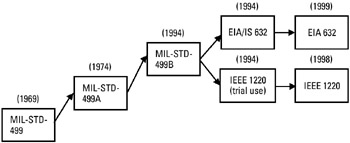
The evolution of systems engineering standards is shown in Figure 6.1 to illustrate the history and previous standards upon which current standards are based. In the following sections, we briefly describe the standards from MIL-STD-499B onwards.
MIL-STD-499B was written within the U.S. DoD and released in draft form in 1994 to replace MIL-STD-499A, which was dated 1 May 1974. The Bravo version of 499 was never released other than in draft form. In 1994 the U.S. government, through the Perry initiative, directed that most U.S. military standards were to be cancelled. In fact, another standard reviewed in this section (EIA/IS 632) is considered to be the demilitarized version of MIL-STD-499B. Even though MIL-STD-499B was not officially released, it (like its predecessor) was, and still is, widely considered...