The Mathcad 2001i Handbook

In this chapter we are going to consider the procedures involved in solving non-linear algebraic equations and systems of such equations.
The task is formulated as follows. Let us imagine that we have a single algebraic equation with an unknown value x
f(x)=0,
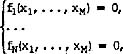
or the following system of N algebraic equations
where f(x) is some function. It is necessary to find all equation roots, in other words, all x values that turn the equation (or the system of equations) to the true equality (or set of true equalities).
| Note | Solving systems of linear equations where all functions have the following form: f i(x)= a i1*x 1+a i2*x 2+ +a iN*x N, is a separate problem of linear algebra. It will be covered in more detail in Chapter 9. |
Usually, numeric methods of finding equation roots are related to solving the following problems:
Investigating root existence, determining the number of existing roots and their approximate location
Calculating the roots with the predefined TOL error
The latter problem makes it necessary to find such x 0 values whose f(x 0) difference from zero doesn't exceed the TOL value. Nearly all built-in Mathcad functions intended for solving non-linear algebraic equations are aimed at solving the second task. This means that they suppose that equation roots are approximately localized. To solve the first task (root localization), one can use various methods, such as, graphical f(x) representation...