Measurement Systems and Sensors

A slotted line in a computer measurement system requires a circuit amplifying the signal power and matching the signal level with the operating range of an ADC. Analog circuits performing such functions are conditioners, manufactured in two groups. The first group consists of analog-to-analog converters current-to-voltage, voltage-to-voltage, and voltage-to-current, with different ranges of input signal. The other group contains circuits cooperating with sensors of physical quantities with defined parameters and measuring range [1]. Circuits cooperating with thermocouples and Pt100 resistance temperature sensors constitute the most numerous group among them. For sensors such as thermocouples and strain gauges, signal conditioning is very important.
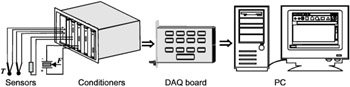
In industrial computer-based measurement systems, conditioners are placed between sensors and a plug-in DAQ board, or between sensors and a digital instrument. The signal flow in such systems is shown in Figure 4.1.
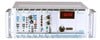
Apart from conditioners in the form of integrated circuits, there are also conditioners in the form of modules, on which terminals for connecting sensors are placed. These devices may also be equipped with an amplifier. The most important component of such a conditioner is an integrated circuit. Examples of such conditioners are devices made by Analog Devices. There are conditioners for RTD sensors, thermocouples, and strain gauges. Voltage conditioners, both single-ended amplifiers and differential amplifiers, may also be included in the group of signal conditioners. National Instruments has developed two modular signal conditioning platforms the compact conditioning system SCC and the high-performance multichannel system SCXI. There...