Measurement Systems and Sensors

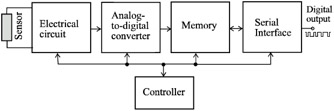
Many objects or technical devices are monitored or controlled by means of a sequence of sensors. An example of such a technical device is a car, and examples of such objects are a public utility or an apartment building. A medium-class car is equipped with approximately 100 sensors of temperature, pressure, stresses, or chemical constitution of exhaust gas. Efficient use of information gained from so many sensors is possible after connecting the sensors into a computer (or microprocessor) measurement system. A measurement line in such system should transmit a digital signal. Due to needs reported by industry, and due to great progress in electronic technology, the production of a new generation of sensors has become possible, the so-called smart sensors. The adjective "smart" should describe the adjusting properties of such a sensor (e.g., automatic selection of analog signal amplification). Functionally, the smart sensor is a converter of a measured quantity into a digital output signal. As far as the sensor structure and functions are considered, an equivalent of a smart sensor is simply a digital sensor. A smart sensor is an integrated device including the following elements or functional blocks a sensor of physical quantity (e.g., electronic analog temperature sensor); a measurement circuit (e.g., Wheatstone bridge in the case of resistance gauges); an ADC; memory; a serial interface; and a control system (see Figure 6.36).
Smart sensors as analog-digital integrated devices have a limited working...