Mesh Generation
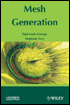
Including coverage of mesh modification tools, evaluation criteria, optimization, and more, this book provides a comprehensive survey of the different algorithms and data structures for triangulation and meshing construction.
 TABLE OF CONTENTS
 In practical terms and notably in applications related to geometric modeling and graphical visualization, the usual representation of curves and surfaces is the parametric one (cf. Chapters 12 and 13). Nevertheless, other representations exist and are employed to some extent depending on the applications envisaged. An explicit representation is based on functions of the form z = f(x, y). This approach is quite limited in practice, as the surfaces defined in this way are usually rather "rudimentary" or do not correspond to concrete cases. A third approach consists of defining a surface as the set of points ( x, y, z) in  , which are solutions of an equation of the type f(x, y, z) = 0. The study of such surfaces, called implicit surfaces, is the subject of this chapter.
Interest in implicit curves and surfaces has increased over the last few years, notably due to the emergence of discrete (sampled) data for modeling computational domains. Discrete geometry attempts to transpose the results of classical (affine and differential) geometry to the discrete field. However, as pointed out by [Hoffmann-1993], the application field of implicit functions seems to remain largely underestimated.
Given an implicit curve or surface representing the boundary of a computational domain, we focus here on the problem of meshing this boundary. In the first section, we recall some basic definitions and properties of implicit functions. Then, we deal with the mesh generation of implicitly defined planar curves. In...