Metal Fatigue: What It Is, Why It Matters
Chapter 7: The Cracked Situation

7.1 Introduction

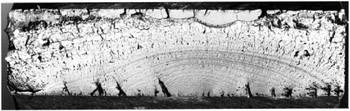
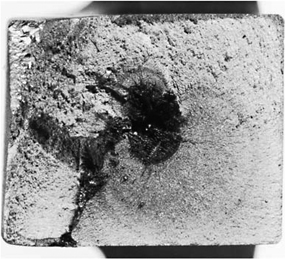
Because of the nature of metal fatigue mechanisms, the fatigue lives of specimens, components and structures are sometimes dominated by fatigue crack initiation, and sometimes by fatigue crack propagation (see Sections 3.4, 6.1 and 6.5). From a practical viewpoint, probably the most significant advance in the understanding of metal fatigue behaviour was the general realisation, some 30 years ago, that many components and structures are crack propagation dominated (Frost 1975). Cracks, or crack like flaws, may be introduced during manufacture, especially if welding or casting is used, or cracks may form early on during service (Pook 2000a, Murakami 2002). As examples of cracked situations, Figure 7.1 shows multiple fatigue cracking from crack like flaws in a 25 mm thick structural steel cruciform welded joint, and Figure 7.2 fatigue cracking from shrinkage in a 30 35 mm cast steel bar.


Figure 7.1: Fatigue cracking in a 25 mm thick structural steel cruciform welded joint showing programme markings, specimen A2/5 (Pook 1983b). Reproduced under the terms of the Click-Use Licence.

Figure 7.2: Fatigue cracking from shrinkage in 30 35 mm cast steel bar. National Engineering Laboratory photograph. Reproduced under the terms of the Click-Use Licence.

In the presence of an actual or postulated crack, determining the fatigue life requires finding the number of cycles needed to propagate a fatigue crack from the initial crack size, a i, to the final crack size, a f, at which static failure takes place. This...

UNLIMITED FREE
ACCESS
TO THE WORLD'S BEST IDEAS

SUBMIT
Already a GlobalSpec user? Log in.

This is embarrasing...

An error occurred while processing the form. Please try again in a few minutes.

Customize Your GlobalSpec Experience

Category: Drill Pipe
Finish!
Privacy Policy

This is embarrasing...

An error occurred while processing the form. Please try again in a few minutes.