Metal Fatigue: What It Is, Why It Matters

A.4: Corner Point Singularities

A.4 Corner Point Singularities

The analyses on which the concept of stress intensity factor is based are essentially two dimensional in nature, and the crack front is a point (see Section A.3.2). When analysis is extended to three dimensions, the crack front becomes a line. Derivations then include the implicit, and usually unstated, assumption that a crack front is continuous. This is not the case at a corner point, where a crack front intersects a free surface. The crack front shown by the dashed line in Figure A.15 intersects the surface at two corner points. As is well known, the nature of the crack tip singularity changes in the vicinity of a corner point. For corner point singularities, the polar coordinates ( r, ?) in Figure A.1 are replaced by spherical coordinates ( r, ?, ) with origin at the corner point. The angle is measured from the crack front.


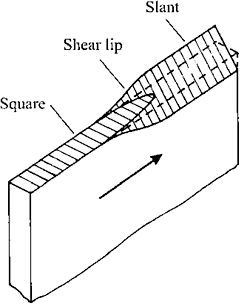
Figure A.19: Transition from square to slant crack propagation in thin sheets. The arrow shows the direction of fatigue crack propagation (Pook 1983a). Reproduced under the terms of the Click-Use Licence.

The stress intensity measure, K ?, is used to characterise corner point singularities, where ? is an exponent defining the corner point singularity. Stresses are proportional to K ? /r ? and displacements to K ? r 1 ? ?, where r is measured from the corner point. For a crack surface intersection angle, ?

UNLIMITED FREE
ACCESS
TO THE WORLD'S BEST IDEAS

SUBMIT
Already a GlobalSpec user? Log in.

This is embarrasing...

An error occurred while processing the form. Please try again in a few minutes.

Customize Your GlobalSpec Experience

Category: Strain Gauges
Finish!
Privacy Policy

This is embarrasing...

An error occurred while processing the form. Please try again in a few minutes.