Mobile Antenna Systems Handbook, Third Edition
Simon R. Saunders
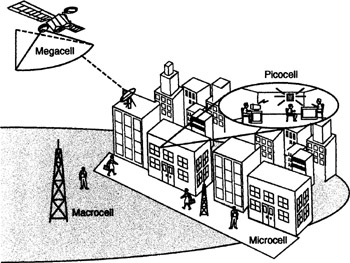
This chapter surveys recent advances in methods of predicting the coverage and capacity of modern mobile systems. The increasing trend is toward systems with very heterogeneous cell types, including cells of radius from tens of meters up to thousands of kilometers. These cells enable operators to provide an appropriate trade-off between wide-area coverage, using a minimum of equipment, together with high capacity in areas with high traffic densities, tailored to the topography of the local area. The most appropriate propagation prediction technique for a given system is highly dependent on the cell type under investigation. Each of the four major cell types (Figure 3.1) is described in this chapter (macrocells in Section 3.2, microcells in Section 3.3, picocells in Section 3.4, and megacells in Section 3.5) together with a description of state-of-the-art prediction techniques in each case. For each model a basic description is given, frequently with equations and example predictions, together with references to permit the reader to pursue them in more detail. Finally, Section 3.6 provides an exposition of future trends. Much of the contents of this chapter are adapted from [1], to which the reader is referred for further detail.
Macrocells (tens of kilometers) are formed by base stations, having antenna heights that are considerably in excess of the heights of the surrounding clutter, including both trees and buildings. Typical installations are shown in Figure 3.2. As a result, the general shape of the...