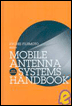
Mobile Antenna Systems Handbook, Third Edition
Santana Burintramart
Nuri Yilmazer
Arijit De
Tapan K. Sarkar
Magdalena Salazar-Palma
Kwok Wa Leung
Edward Yung
In this chapter, the multiple-input multiple-output (MIMO) system is discussed. MIMO utilizes its space diversity to enhance system performance through increasing the received signal power and/or transmission rate. At the beginning of the chapter, the idea of diversities is introduced and applied to multiple antenna communication systems. Then, the chapter discusses some well-known techniques that theoretically make MIMO systems work along with a performance metric called channel capacity. In the last part of the chapter, MIMO systems are investigated under an electromagnetic viewpoint, as when antennas are deployed in real systems, many assumptions of MIMO systems are not valid; therefore, some performance degradation would be expected.
There has been an explosive growth in the wireless communication area in recent years. This growth has forced the system designers to increase the quality of service, coverage, and bandwidth. MIMO wireless communication has become an active research area for some time since Foschini [1] developed the Bell Laboratories layered space-time system (BLAST). Since then, the potential of using multiple antennas to improve the performance of communication systems, especially the capacity, has become more promising. The MIMO systems offer another domain (i.e., spatial domain) in a system design consideration. With this additional domain, it is possible to increase the system capacity or data transfer rate without increasing the bandwidth of the systems. This improvement in bandwidth efficiency of wireless systems is one of the ultimate goals...