Modern Microwave Circuits

Including over 1,200 equations and more than 300 illustrations, this invaluable book explains how microstrip circuits are built and provides in-depth coverage of computer-aided simulation and underlying theories.
 TABLE OF CONTENTS
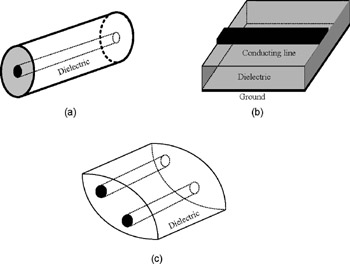
 In general, circuits and networks are made up of some components that perform operations on the signals and of some others that only carry signals from one place to another with minimum distortion on the signals. These components that are responsible for the transmission of signals are called the transmission lines (TL), and they come in various shapes and forms [see Figure 1.6(a c)]. It is obvious that those components performing operations on the signals vary from circuit to circuit, depending upon their intended functions, but the ones that perform transmission always exist in circuits and are indispensable. So, the transmission lines are probably one of the most basic components in any network. For microwave circuits and antennas, the characterization of transmission lines plays a much more important role than their characterization for low-frequency circuits. This is because the transmission lines are extremely short for low-frequency circuits in terms of wavelength (an exception is the ac power distribution lines, but we will not discuss them here) and can be modeled by considering only the bulk resistance, which is close to zero in most cases, between their terminals. However, for microwave and antenna applications, they are no longer short as compared to wavelengths, and hence it is necessary to include their influence on the signals passing through them.
For the characterization of transmission lines in high-frequency applications, a special method that utilizes circuit theory...