Modern Sensors Handbook

Chapter written by Stanislav ?A?O and Jan FISCHER.
Optical sensors are measuring devices in which a measured quantity is converted to an optical and, subsequently, an electrical signal by means of an optoelectronic transducer ([10]). Optical sensors belong to the class of contactless methods of measurement eliminating backward influence of a measuring device on an object of measurement.
As output signals from optical sensors are of an electronic nature and the methods of their further conditioning are generally known, the main attention will be devoted to the optical part of a sensor.
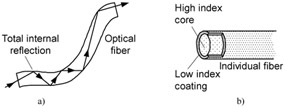
The simplest structure of an optical fiber used in optical sensors consists of a circular core with a cylindrical coating layer ([33]).
The index of refraction of a core, n j, is always larger than that of coating, n p. The zero loss propagation of light along the fiber requires the fulfillment of conditions for the total internal reflection, which are reached for angles of incidences larger than a certain value called a critical angle.
For internal reflection on the boundary between the core and the coating (Figure 2.1) the value of the critical angle may be found from the formula
| (2.1) | |
The light introduced into the fiber with a certain angle will continue to reflect off the walls of the fiber and thus can travel long distances in the fiber.
The maximum value of the...