Modern Sensors Handbook

Chapter written by R. MEYLAERS, F. PEETERS, M. PEETERMANS and L. INDESTEEGE.
Measuring the flow of liquids, gases, steam or solids is important both for the processing industry and for occasional readings. In some processes inaccurate flow-rate measurement can make the difference between profit and loss. In other cases inaccurate or erroneous flow measurements can have serious or even disastrous consequences.
The flow (Q) is defined as the amount of a substance that passes a certain point or a certain section during one time unit.
We make a distinction between volume-flow measurements and mass-flow measurements (Q v and Q m).
Many principles of volume-flow measurements use the following formula:
| (3.1) | |
where
Q v: volume flow [m 3/s]
v: mean velocity [m/s]
A: cross-sectional area [m 2]
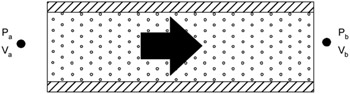
The flow is determined by measuring the velocity or the change in kinetic energy of the medium. The velocity depends on the difference in pressure on a pipe or covering (Figure 3.1). This pressure difference pushes the medium through the pipe or covering. Because the pipe's diameter is known, the average velocity is a measure of the flow.
The International System unit for volume flow is m 3/s, but often m 3/h or 1/h are used.
We note that in practice the flow is usually expressed as a volume flow and less as a mass flow.
When dealing with incompressible substances like...